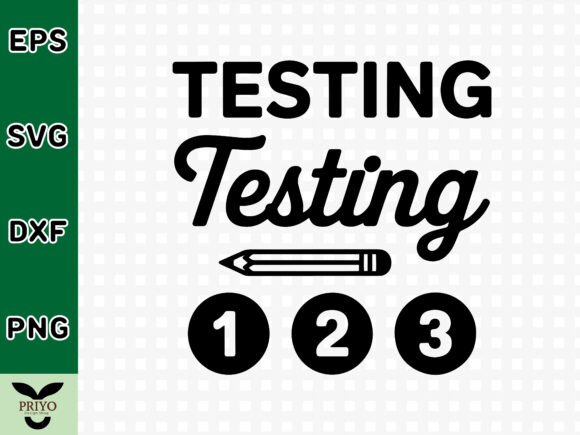
Testing Testing 1 2 3 SVG
A Designer’s First Look: Playful, Precise, and Purpose-Built
When I opened Testing Testing 1 2 3 SVG in my design software, what struck me first wasn’t just the clean typography—it was the quiet confidence in its simplicity. This isn’t a shouty, overdesigned graphic. It’s a warm, approachable phrase with rhythm and balance: three words, three numbers, two spaces, one breath. As an embroidery designer who’s stitched hundreds of phrases onto baby onesies, boutique aprons, and craft fair totes, I immediately saw its potential—not as filler, but as intentional branding.
Real-World Use Case: A Custom Embroidered Tote for a Local Bakery
Last week, I prepped a small batch of linen-cotton blend tote bags for “Hearth & Crumb,” a neighborhood bakery launching their weekend pop-up. They wanted something friendly but not cutesy—something that hinted at craft, care, and behind-the-scenes effort. Testing Testing 1 2 3 SVG landed perfectly on the lower left corner of each bag, sized to 3.2” wide and stitched in soft oatmeal thread. The result? Customers paused. Smiled. Asked, “Is that your motto?” It felt like a shared wink—not a slogan, but a quiet nod to process, practice, and getting it right.
Where It Shines in Embroidery Projects
- Custom apparel: Works beautifully on crewneck sweatshirts (especially mid-back or left-chest), where its even weight and open letter spacing prevent crowding.
- Tote bag design: Holds clarity at 2.5–4”, reads cleanly from arm’s length, and avoids the “dense blob” effect common with overly compact phrases.
- Baby embroidery: Gentle scale and no sharp angles make it ideal for onesies or burp cloths—soft enough for delicate skin, distinctive enough for gifting.
- Embroidered patch: Translates well into a 2.75” circular or rectangular patch; the consistent stroke width supports clean satin stitch edges without fraying.
- Holiday embroidery & personalized gifts: Feels nostalgic but fresh—perfect for handmade ornaments, tea towel sets, or “first kitchen” bundles for new grads.
- Craft business branding: Small shop owners and Etsy sellers can use it subtly on packaging tags, receipt tape, or product labels to reinforce authenticity and care.
Where to Proceed Thoughtfully
This isn’t a one-size-fits-all embroidery file—and that’s a strength, not a limitation. Here’s where attention pays off:
- Small hoop sizes (under 4”): The “3” has subtle curve detail—test stitch density before scaling below 2”. At tiny sizes, running stitch outlines may soften; consider simplifying the numeral if needed.
- Textured fabrics (terry cloth, heavy canvas): Fill stitch areas hold up well, but avoid placing the design directly over thick seams or raised weaves—opt for flat panels like the front chest or center back.
- Stretchy fabric (knits, jersey): Requires cutaway stabilizer underneath and light topping—especially around the numerals—to prevent distortion during hooping and stitching.
- Dark fabric: Light thread colors (cream, pale gray, mint) read clearly, but avoid very thin white thread—it can look washed out. Test contrast with your actual fabric swatch.
- Curved surfaces (caps, beanies): The horizontal layout means it’s best suited for front panels—not curved sides or back straps. For caps, place it centered above the visor seam.
- Frequent-wash items (baby clothes, kitchen towels): Confirm stitch density isn’t too sparse—if fill stitches are widely spaced, they may pull or snag over time. A balanced density (not ultra-light, not over-packed) ensures longevity.
What It Adds to Your Finished Product
Testing Testing 1 2 3 SVG doesn’t scream “look at me.” Instead, it builds trust through tone. When stitched onto a handmade pillow cover or small-batch apron, it signals intention—not just decoration. Customers recognize craftsmanship in restraint. That matters for Etsy sellers pricing hand-stitched goods, for craft fair vendors building repeat buyers, and for small shops wanting cohesive, recognizable design assets.
It also bridges digital and physical seamlessly. As a digital embroidery file, it works cleanly in printable mockups—no jagged edges, no stray anchor points. As a machine embroidery design, its vector-based structure (typical of SVGs) allows smooth resizing without pixelation—critical when adapting for patches, mugs, or posters later.
Practical Notes Every Embroidery Designer Should Run Through
- Always test Testing Testing 1 2 3 SVG on scrap fabric matching your final project’s weight and stretch.
- Check thread color contrast using both black-and-white and color mockups—some light grays disappear on heathered tees.
- Review stitch density: if your machine defaults to high-density fills, reduce by 5–10% for breathable fabrics like cotton poplin or linen.
- Confirm hoop size compatibility—this design fits comfortably in a 4×4 hoop at standard scale, but verify before loading into your embroidery software.
- Inspect corners and curves in preview mode: the “2” and “3” have gentle terminals—ensure no underlay is missing there.
- Use proper stabilizer: tear-away for stable wovens, cutaway for knits or lightweight blends.
- Ask yourself: does this support my brand voice? If you sell minimalist nursery decor, yes. If you specialize in bold, glitter-heavy party wear, it may need pairing with bolder elements.
- Verify licensing: since it’s listed under Graphics in the Crafts category, confirm whether commercial use (e.g., selling embroidered totes with this design) is permitted before listing on Etsy or at craft fairs.
Final Thought: Less Is Anchored, Not Empty
In a world of oversized fonts and aggressive motifs, Testing Testing 1 2 3 SVG stands out by holding space—not filling it. It’s the kind of embroidery file that makes your handmade product feel considered, your custom apparel feel personal, and your small shop feel human. It won’t carry every project—but when it fits, it lands with quiet authority. And in embroidery, that’s often exactly what makes a design unforgettable.