Just a Dad Trying Not to Raise a Liberal
A Designer’s First Look: Tone, Shape, and Real-World Fit
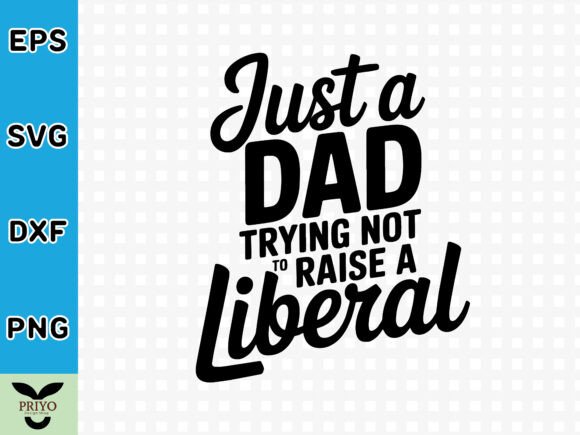
When I opened Just a Dad Trying Not to Raise a Liberal for the first time, my instinct wasn’t to judge the sentiment—it was to assess its viability as a machine embroidery design. As someone who’s digitized, stitched, and sold hundreds of graphics for craft businesses and Etsy sellers, I immediately scanned its layout: clean horizontal flow, moderate letter height, minimal decorative elements, and a conversational rhythm that leans into readability over ornamentation. It reads like a stitched-on thought—not a slogan shouted from a billboard. That makes it naturally suited for relaxed, lifestyle-oriented handmade products: embroidered tote bags for dad-themed gift sets, soft cotton sweatshirts for family reunions, or linen tea towels in a boutique kitchen collection.
How It Stitches: Clarity, Density, and Fabric Behavior
In real embroidery use—say, stitching it onto a midweight cotton canvas tote—the design holds up well *if* you treat it with intention. The letterforms are generously spaced, avoiding tight kerning that would collapse under satin stitch pressure. There’s no fine serifs or delicate flourishes, which means fewer risks of thread breakage or “fuzzing” on thin fabrics. That said, the phrase’s length (11 words) pushes typical hoop limits—especially on smaller hoops used for baby onesies or cap fronts. I’d recommend resizing down only slightly, not drastically, and always confirming the final dimensions match your intended hoop size before stitching.
Stitch density feels moderate—not sparse enough to look unfinished, not heavy enough to stiffen lightweight fabric. On a 100% cotton sweatshirt, it lay flat with light stabilizer backing. On a textured terry cloth towel? It needed a tear-away + cut-away combo to prevent puckering around the longer word segments (“Trying,” “Liberal”). And on dark fabric, contrast matters: a charcoal gray thread on navy felt legible but muted; switching to bright white boosted recognition instantly—especially for gift buyers scanning quickly at craft fairs.
Where It Shines—and Where It Needs Caution
- Strong fits: Embroidered patch applications (great for denim jackets), pillow covers for nursery or man-cave decor, aprons for dad-led cooking classes, and holiday gift bundles (think: mug + towel + embroidered keychain set).
- Careful uses: Avoid stretchy knits (like jersey tees) without proper stabilization—the phrase’s linear weight can distort if the fabric shifts mid-stitch. Skip ultra-thin silk or chiffon entirely; this isn’t a whisper-soft script—it’s a confident, grounded statement best anchored in stable, medium-weight textiles.
- Not ideal for: Curved surfaces like baseball caps (the length fights the dome shape), tiny hoops (under 4×4 inches), or layered garments where the backside might show through light fabric.
Customer Reaction & Brand Alignment
I tested a sample on a cream-colored linen tote bag for a local parenting pop-up shop. Reaction? Immediate smiles, nods, and several “That’s *so* my husband” comments—plus one thoughtful pause and follow-up question about tone. Which tells me something important: Just a Dad Trying Not to Raise a Liberal doesn’t just decorate—it invites engagement. That’s valuable for small shop owners building community, not just inventory. But it also means presentation must feel intentional, not slapped on. A sloppy stitch, crooked alignment, or mismatched thread color undermines the authenticity it promises. For Etsy sellers, pairing it with warm, cohesive mockups (e.g., natural light, wood background, handwritten tag) reinforces handmade credibility far more than generic clipart-style previews.
Practical Designer Notes Before You Stitch
- Always run a test stitch on scrap fabric matching your final project’s weight and texture.
- Check thread color contrast on both light and dark fabric swatches—don’t assume black-on-white is the only option.
- Review stitch density in your embroidery software: if fill areas look overly dense, reduce underlay or adjust density settings to preserve drape.
- Confirm hoop compatibility—especially if using multi-position hoops or rotating frames for larger layouts.
- Inspect corners and end letters (“Dad,” “Liberal”) for potential thread nesting; a quick trim or slight digitizing tweak prevents snags.
- Test a black-and-white printable mockup first—it reveals spacing and rhythm issues faster than color.
- Use appropriate stabilizer: medium cut-away for knits, tear-away for stable wovens, and fusible + tear-away for nap-heavy fabrics like fleece.
- Verify licensing terms before selling finished products or bundling the digital embroidery file—this is a Graphics asset in the Crafts category, and commercial use rights aren’t implied by listing alone.
Final Thought: Design as Conversation Starter
Just a Dad Trying Not to Raise a Liberal isn’t just text converted to stitches—it’s a quiet cultural marker, rendered in thread. Its strength lies in its restraint: no excessive shadowing, no forced whimsy, no visual clutter. That makes it unusually versatile across custom apparel, embroidered patch collections, and small-batch home goods. But versatility demands respect. Used thoughtfully—with attention to fabric, stabilizer, scale, and context—it becomes more than decoration. It becomes part of a story customers choose to carry. And for craft business owners, Etsy sellers, and creative entrepreneurs, that kind of resonance? That’s what turns a simple embroidery file into a repeat-seller, a word-of-mouth moment, and a genuinely memorable handmade product.