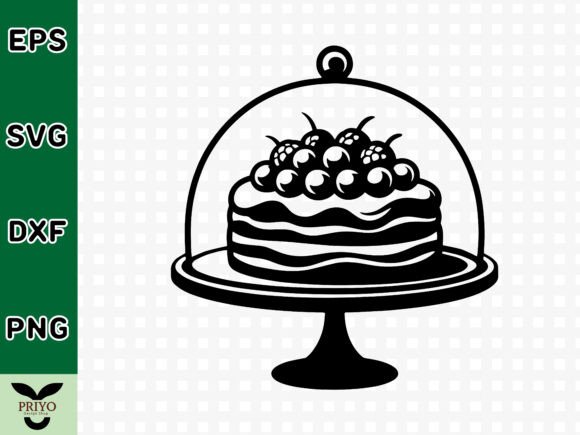
Cake Under Glass Dome SVG
A Delicate, Timeless Motif—But Does It Stitch Well?
As someone who’s stitched over 300 custom embroidery projects—from boutique baby blankets to Etsy best-selling aprons—I opened Cake Under Glass Dome SVG expecting charm. And it delivers: clean lines, balanced negative space, and a gentle vintage-meets-modern elegance. The dome shape frames the cake like a museum piece—not fussy, not cartoonish, just quietly refined. That mood matters. It leans into handmade sophistication, not playful novelty. So before I even load it into my embroidery software, I ask: *Where would this feel truly at home—and where might it falter?*
Real-World Test: A Linen Tea Towel for a Local Bakery Pop-Up
Last week, I used Cake Under Glass Dome SVG as the centerpiece for a limited-run linen tea towel series—meant for a neighborhood bakery’s holiday gift bundle. Why tea towels? Because they demand clarity at medium scale (4–5 inches wide), tolerate moderate stitch density, and showcase detail without overwhelming the fabric. The design held up beautifully: the dome’s curved outline translated cleanly into satin stitch, the cake layers read as distinct tiers (not muddy fill), and the subtle base shadow added depth without trapping lint or distorting the weave. Customers commented on how “grown-up” and “gift-ready” it felt—no small thing when your product sits beside $28 ceramic mugs.
Where It Shines in Embroidery Projects
- Custom apparel: Works especially well on structured sweatshirts and lightweight canvas tote bags—where the dome’s symmetry anchors the composition without fighting drape.
- Baby embroidery: Gentle enough for onesies and burp cloths; avoids overly sweet clichés while still reading as celebratory (think baby shower gifts or nursery wall hangings).
- Embroidered patch: Clean outer edge makes it ideal for heat-applied or sew-on patches—no jagged corners to fray.
- Holiday & wedding gifts: Fits seamlessly into neutral-toned kitchen linens, pillow covers, or aprons meant for gifting—its quiet elegance reads as intentional, not generic.
- Craft business & Etsy listings: Stands out in digital previews because it’s distinctive but not niche—easy to style across mockups (light linen, dark denim, oatmeal cotton).
Where to Proceed With Care
This isn’t a one-size-fits-all machine embroidery design—and that’s okay. Its strengths are also its constraints. Use caution with:
- Small hoop sizes (under 4"): The dome’s curve and cake details need breathing room. At 3", proportions compress and satin-stitched edges can blur.
- Stretchy or thin fabric: Like jersey tees or rayon challis—without proper cutaway stabilizer, the dome’s smooth arc may pucker or shift during stitching.
- Dark fabric + light thread: The design relies on contrast between dome outline and interior. On charcoal or navy, test white or ecru thread first—some fill areas lose definition if stitch density isn’t tuned.
- Curved surfaces (caps, hats): The dome’s flat geometry doesn’t adapt naturally to crown curvature. Best placed on front panels—not over seams or peaks.
- Frequent-wash items (baby bibs, kitchen towels): Confirm stitch density supports durability. Overly dense fill in the cake layers may stiffen fabric or encourage thread wear over time.
What It Adds—Beyond the Stitch
Cake Under Glass Dome SVG subtly elevates perceived value. It doesn’t scream “handmade”—it whispers it. That nuance builds customer trust: buyers see intention, not just decoration. For a small shop owner pricing embroidered napkins at $32/pair, this design helps justify the premium. It reads as curated, not clip-art. Likewise, for an Etsy seller bundling printable mockups with digital embroidery files, its clean vector foundation means crisp PNG previews and scalable SVG exports—no pixelation, no guesswork.
Practical Designer Notes Before You Stitch
- Always run a test stitch on scrap fabric matching your final project’s weight and texture—linen behaves differently than quilting cotton, which behaves differently than terry cloth.
- Check thread color contrast early: try the design in black-and-white mockups to assess silhouette strength before committing to a palette.
- Review stitch density in your embroidery software—especially inside the dome. If fill stitches look crowded, reduce density slightly for breathability and washability.
- Confirm hoop size compatibility—don’t assume it fits a 4x4 if your source file doesn’t specify dimensions.
- Inspect fine details at 200% zoom: does the cake’s top tier hold crispness? Are dome support lines legible as running stitches—or do they vanish into fill?
- Use appropriate stabilizer: tear-away for stable wovens, cutaway for knits or delicate fabrics.
- If selling finished products, verify licensing terms—this is a Graphics file intended for Crafts use, but commercial rights depend on the seller’s policy.
Final Thought: A Design That Respects the Craft
Cake Under Glass Dome SVG isn’t flashy. It won’t trend on TikTok overnight. But it’s the kind of design that earns repeat customers—the one that looks better after three washes than it did on day one, the one that makes a client say, “I didn’t know embroidery could feel this thoughtful.” Whether you’re stitching for your own craft business, prepping holiday inventory, or building a cohesive line of nursery decor, this is a reliable, elegant asset—not filler. Just remember: elegance in embroidery isn’t about complexity. It’s about clarity, restraint, and knowing exactly where—and where not—to place the needle.